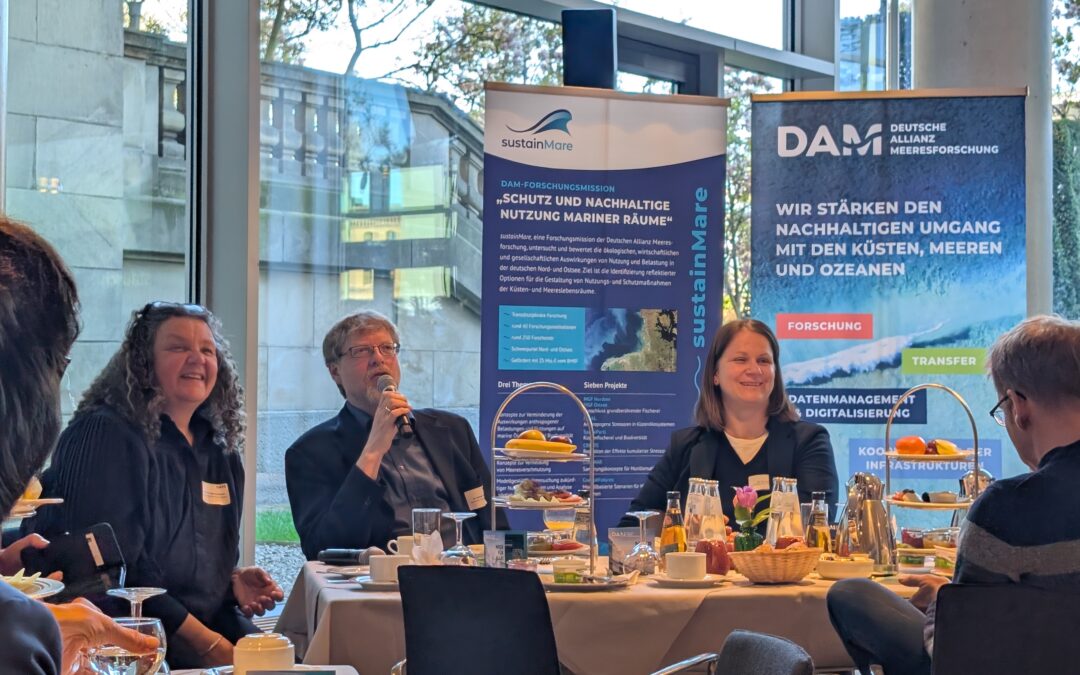
Prof. Dr. Corinna Schrum, Dr. Ute Daewel, and Dr. Andreas Kannen from the Helmholtz Center Hereon provided the scientific impetus with findings from the sustainMare research mission. Their key message: While this expansion significantly alters the marine environment, it is also a central component of energy security, climate neutrality, technological development, and employment. It is crucial to consider nature, the marine environment, and energy policy together rather than separately by sector. DAM and sustainMare have summarized the options for action in seven recommendations for a science-based maritime policy.
Andreas Kannen, one of the spokespersons for the sustainMare research mission, also works as a researcher at the 70 GW Offshore Wind living lab. Also present was living lab spokesperson Prof. Dr. Torsten Schlurmann, who serves on the DAM Executive Board.
To mark this occasion, the DAM has published a position paper on shaping science-based marine policy. It can be downloaded here: OFFSHORE WIND POWER: THE NEW CHALLENGE FOR THE MARINE ENVIRONMENT
Photo: DAM/German Alliance for Marine Research

