Aims and methods of the Living Lab
In conjunction with the overall TEN.efzn project, the research platform “Reallabor 70 GW Offshore Wind” is creating a unique research and innovation ecosystem in which a demand-oriented topic area with great scientific potential is addressing a holistic view of the planned expansion of wind energy in the German North Sea by 2045 for the first time. This approach is reflected structurally in five areas of innovation. In addition, there are already indications of overlaps with the other research platforms.
For the first time, the “Reallabor Offshore” is linking technical research to maritime spatial planning, which is not only based on modeling wind energy yields, but also considers environmental impacts and co-use aspects. Technical innovations will not only be based on performance, longevity and costs, but also on the consequences for the marine environment. These in turn, together with the necessary structural change in coastal regions, which also offers great opportunities, are decisive for the social acceptance and support of the massive expansion of offshore wind energy.
Organization of the Living Lab
The spokesperson team of the Reallabor 70 GW Offshore Wind represents the research platform externally. They are the contact persons for the press and the public. The coordinator is responsible for project management, administration and the exchange and networking with the other research platforms in TEN.efzn.
Prof. Dr. Kerstin Avila
Prof. Dr.-Ing. habil. Torsten Schlurmann
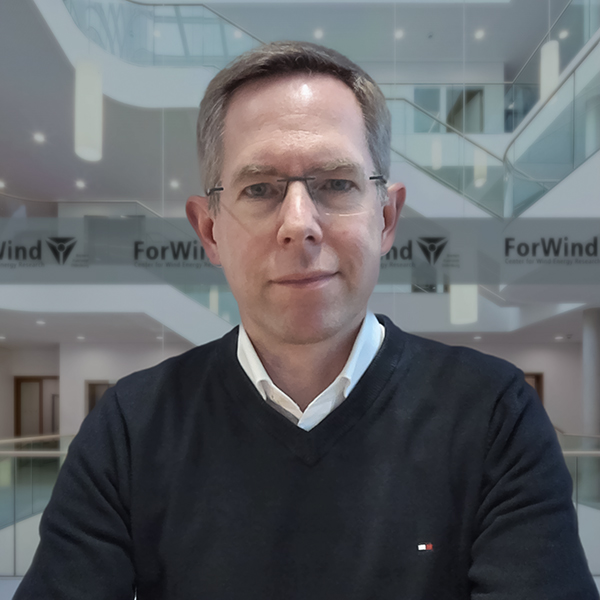
Dr. Stephan Barth
Funding
The Living Lab 70 GW Offshore Wind is funded by zukunft.niedersachsen, the joint science funding program of the Lower Saxony Ministry of Science and Culture and the Volkswagen Foundation.
Beteiligte Forscher*innen nach Institution
Participating research institutions and industry partners

Carl von Ossietzky University of Oldenburg
The Institute of Physics focuses on applied wind physics. Research ranges from turbulence and complex systems to the analysis of atmospheric processes for wind energy. Central topics are wind measurements onshore and offshore, high-resolution simulations, wind and power forecasts from measurement and operating data, control of wind turbines and wind farms as well as the design of offshore wind turbines. Field and wind tunnel experiments are closely linked to simulations.
The Institute for Chemistry and Biology of the Marine Environment (ICBM) is an interdisciplinary center for marine research in Oldenburg and Wilhelmshaven. It covers a broad field of marine research and teaching and brings together many working groups from the natural and engineering sciences. This includes a coastal observatory and sea-based research infrastructure.
Ecological economics contributes social science expertise to transdisciplinary projects. Research focuses on climate adaptation, coastal protection and sustainable land use with the involvement of social stakeholders.

Leibniz University Hanover
The research activities of the Ludwig-Franzius-Institute for Hydraulic, Estuarine and Coastal Engineering include coastal protection, marine and offshore technology, risk and vulnerability research in coastal zones as well as field measurements in Germany and abroad. Large-scale wave and current channels, a state-of-the-art measuring boat and powerful computing clusters for numerical simulations enable the processing of scientific and application-oriented issues.
The Institute of Statics and Dynamics deals with multifunctional, filigree and durable components and support structures for wind energy, construction, automotive and mechanical engineering as well as aerospace. It is also the spokesperson for the DFG-funded Collaborative Research Center 1463 Offshore Megastructures.
The Department of Electrical Energy Supply at the Institute of Electrical Energy Systems has proven expertise in the modeling and simulation of electrical energy systems, the planning and management of electrical grids at all voltage levels as well as in grid control, redispatch and stability analysis.
TU Braunschweig
The Leichtweiß Institute of Hydraulic Engineering at TU Braunschweig conducts research in the fields of hydromechanics, coastal engineering and marine engineering. In addition to the further development of classical coastal engineering, research into the use of marine environments, e.g. marine renewable energy, is a focal point. The existing research infrastructure, such as wave channels and wave basins, enables outstanding research in this area. TUBS is a member of the Coastal Research Center (FZK), which focuses on experimental research into offshore and coastal infrastructure.
The Institute of Flight Guidance at TU Braunschweig operates various flying platforms (manned research aircraft, helicopter towed probe, various drones) to flexibly obtain high-resolution spatial and temporal data of the atmosphere and the earth’s surface. These unique data sets are used to validate models and wind farm parameterizations.

Sociological Research Institute Göttingen
The Sociological Research Institute Göttingen (SOFI) e. V. was founded in 1968 as a non-commercial, university-affiliated research institute. The registered non-profit association has been an affiliated institute of the Georg-August-Universität Göttingen since 1983 and an associated campus partner since 2020.
SOFI conducts research on the topics of work, public goods and social cohesion and provides impulses for the democratic shaping of society. The institute’s work is based on the principle of application-oriented basic research, which is dedicated to central issues of our time: The projects address issues of digitalization and vocational training as well as the consequences of precarious employment and social inequality. At present, sociological pandemic impact research and the effects of the socio-ecological transformation are also increasingly coming into focus.

Fraunhofer IWES
At the Fraunhofer IWES, we are continuously working on optimizing wind energy and hydrogen technologies. With its research services, the IWES makes a significant contribution to driving forward the transformation of the energy system and substantially reducing the associated costs. With our expertise and unique testing infrastructure, we can systematically identify and minimize development risks for new products and systems. In this way, we help to accelerate the certification and market launch of innovative products and increase their quality level. In this way, we contribute to their reliable functionality and transparent financing.
With our involvement in many development projects in the wind industry and a large number of registered patents, the IWES contributes to innovative strength. We make significant contributions to the energy transition and to a liveable global future.

Helmholtz Center Hereon
The Helmholtz Center Hereon conducts cutting-edge international research for a changing world: around 1,000 employees create knowledge and innovations for greater resilience and sustainability. Hereon’s scientific spectrum includes high-performance materials, processes and environmentally friendly technologies for mobility and new energy systems.
With the help of research and consulting, Hereon meets the challenges of climate change in a solution-oriented manner and enables sustainable management and protection of the coastal and marine environment through comprehensive scientific understanding.
The path from idea to innovation leads through a continuous interplay between experimental studies, modeling and artificial intelligence to digital twins that map the diverse parameters of climate and coast or human biology in the computer.
ForWind - Center for Wind Energy Research
ForWind bundles wind energy research in the northwest and connects 30 institutes and working groups from the universities of Oldenburg, Hanover and Bremen. ForWind thus forms a unique research network in Germany and covers a broad spectrum of scientific topics. Research focuses on the fields of engineering, physics and meteorology, computer science and economics.
ForWind is responsible for the EFZN wind research line at the Energy Research Center of Lower Saxony (EFZN). The EFZN is a joint scientific center of the universities of Braunschweig, Clausthal, Göttingen, Hanover and Oldenburg.
Together with the German Aerospace Center (DLR) and the Fraunhofer Institute for Wind Energy Systems (IWES), ForWind forms the Wind Energy Research Network (FVWE).

RWE Offshore Wind
As a global leader, RWE Offshore Wind is shaping tomorrow’s energy on the high seas. We are active across Europe, U.S., Japan and Korea. We have already 19 wind farms in operation with an installed capacity of over 3 gigawatts. With over 20 years’ experience in developing, building, operating and maintaining offshore wind farms we have established long-term partnerships, working hand in hand with local businesses and communities. Every year, we invest millions of euros in new offshore wind projects and support harbours, educational programmes, local organisations and more. Our passionate workforce is committed to driving technological and sustainable improvements, delivering construction projects on time and within budget to the highest quality and safety standards, and contributing to a clean energy future.

